


Grape anthracnose is one of the important fungal diseases on grapes. Widely distributed all over the world, it mainly causes symptoms such as fruit rot and leaf spots.
symptom
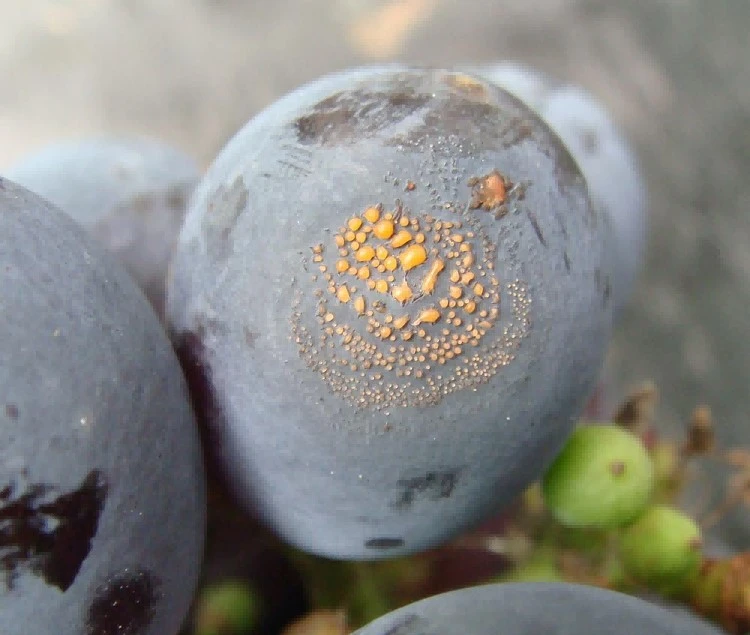
Grape anthracnose mainly occurs on grape fruits and cobs, and can also damage leaves, new shoots, tendrils, fruit stems and other parts, but the symptoms are not as obvious as on fruits and cobs. Infection begins at the early stage of the flower spike, and the infected flower or pedicel turns brown and rots, causing a large number of flower drop, and the whole flower spike rots later. The disease of young fruit usually starts from the top of the ear near the ground. At the beginning of the disease, a pinhead-sized brown round spot occurs on the fruit surface. Later, as the fruit grows larger, the sugar content increases, and the fruit begins to color, the lesion gradually expands and becomes sunken. It becomes soft and rotten, and small black spots arranged in a ring pattern appear on the surface, which are the pycnidia of the pathogen. When the weather is humid, there are crimson slime in the center of the lesion, that is, conidia. When the disease is severe, the lesions can extend to the entire fruit surface and even the whole ear.
On European and American hybrid grapes, the diseased fruit is soft and rotted and falls off; on European grapes, it usually shrinks into black stiff fruit. When infecting new shoots and leaves, the panicles, petioles, and leaf margins also appear round brown disease, and when the humidity is high, pink conidia clusters will also be produced. At the beginning of the disease, the leaves are brown small round spots, and the tips are sunken. When the small disease spots are densely covered on the whole leaf and the disease spots are connected, the leaves often turn yellow and fall off. When the new shoots are damaged, there are pale yellow-brown lesions, and the damaged parts are easy to fall off, and there are crimson slime at the residual marks. Fruiting stems or cobs are morbid, producing dark brown oblong sunken lesions with crimson mucus, and when severe, the ears below the diseased part dry up and fall off.
Transmission routes and disease conditions
The pathogen mainly overwinters with mycelium on the branches and tendrils, and produces conidia in the next year to infect the fruit ears, and most of them carry the fungus on the annual new branches. The occurrence of infection depends on the climate and is related to rainfall. Overwintering pathogens require certain temperature and humidity conditions to form conidia. The conidia begin to form at 15°C, the suitable temperature is 20-30°C, and the spores cannot form if the temperature exceeds 36-40°C; the conditions of rain, dew, and fog are conducive to the formation of spores. A small number of conidia germinate at 15°C, more than half of them germinate at 19°C, the optimum temperature for spore germination is 28-32°C, conidia cannot germinate below 9°C or above 45°C.
In the hot summer, when the grapes are colored and ripe, the disease is often prevalent; under normal circumstances, the conidiophores are a mass of gelatin, which is spread by splashing rainwater, so the dissemination and germination of conidia require a certain amount of water or rainfall. The onset of the disease in the field is closely related to the rainfall, and it is easy to develop the disease a few days after the rainfall, and the disease does not expand significantly during the drought. The occurrence of anthracnose is related to sunburn, and the sunburned fruit is easy to be infected with anthracnose.
The cultivation environment had a significant impact on the occurrence of anthracnose, and the disease was severe in double-stand vineyards and light in wide-row sparse plantations. The incidence of excessive nitrogen application is severe, and the application of potassium fertilizer can reduce the incidence. The disease first occurs from the lower layer of the plant, especially the ear near the ground first, and then spreads upward. The disease is mild in sandy soil, severe in clay soil, and severe in low-lying, stagnant water or poor air circulation.

Prevention method
Agricultural control
Doing a good job of cleaning the orchard is the foundation: when pruning in winter, carefully cut off sick and weak branches and sick and stiff fruits, and bury them deeply or burn them to reduce the source of disease.
Strengthen cultivation management, drain water in time to reduce humidity: tie vines and top off in time to improve the ventilation and light transmission conditions of plants; pay attention to reasonable fertilization, increase phosphorus and potassium fertilizers appropriately, and enhance the tree's disease resistance; when cultivating hedgerows, the minimum The position of the layer of iron wire should be more than 60 cm from the ground.
Conditional orchards, for varieties with high economic value, use facility or rain shelter cultivation. At the same time, adopt trellis shaping and "height, width, vertical" shaping to improve the fruiting position of grapes.
Whole-garden bagging: the fruit grains are as big as soybeans, and ear bagging can be carried out.

chemical control
The focus is on the prevention and control of rainy weather in the early stage, bagging treatment, protection during the color change period and maturity period.
Before germination, spray 5-degree lime sulfur mixture. During the separation of inflorescences, apply 78% Kebo 800 times solution.
Apply 50% carbendazim 600 times or 70% thiophanate-methyl 800-1000 times before flowering. Before bagging, use 1200-1500 times liquid of 22.2% diazomycin, or 4000 times liquid of 97% imazalil, or 3000 times liquid of 50% Baobai liquid water-dispersible granules, or 20% water-dispersed difenoconazole Granules 2000 times liquid treatment ear.
During the veraison and ripening stages, strict monitoring and timely protection are used. The main agents are essential, spraying Fructus, and ammonium methanum; for bagged grapes, mainly Bordeaux mixture, essential, and king copper; non-bagged grapes are sprayed with flavonoids , ammonium ammonium, essential.

If more serious grape anthracnose occurs in the orchard, it proves that the control measures in the early stage of the production season have failed, and emergency measures should be taken. At this time, because the fruit particles are relatively large, it is necessary to appropriately increase the concentration of the drug on the basis of ensuring food safety. If serious grape anthracnose occurs before bagging, use 50% Baobai solution 3000 times + 97% imazalil 4000 times + 20% difenoconazole 2000 times to dip or spray the fruit ears, or use the same Bulky agents are administered together. If grape anthracnose occurs in the later stage, immediately apply 20% difenoconazole 1500 times solution + 10% ammonium magnesium 600 times solution to the whole garden, and then apply 10% ammonium ammonium 600 times solution once 5 days later, and then apply it 5 days later 1200 times liquid is necessary for 80% of 1 time. The dosage and frequency of application can then be determined according to the harvest period. If it rains after the first dose, apply 20% difenoconazole 2,000 times solution + 50% difenoconazole 2,000 times solution immediately after the rain stops, and use the same medicine after 3 days.


